
Because people worldwide tell us that
sexual pleasure matters

Because people worldwide tell us that
sexual pleasure matters
The Good Vibrations Framework emerged from a wave of collaborative efforts between The Pleasure Project, TabuTabu, Young & Alive, Rachel Wilder, and Ester McGeeney. We are also grateful for the valuable feedback received from the Breakthrough Action Network and their partners, as well as from Wendy Knerr.
Sexual pleasure matters.

Gender equity envisages all people being able to equally pursue and experience a satisfying life. Most initiatives aimed at gender equity don’t explicitly include sexual well-being and pleasure. And yet our research with people around the world shows that sexual well-being and pleasure are fundamental aspects of quality of life for many people.
This is backed up by wider research showing that sexual well-being and sexual pleasure are strongly related to gender equity, share many of the same goals and are mutually reinforcing.
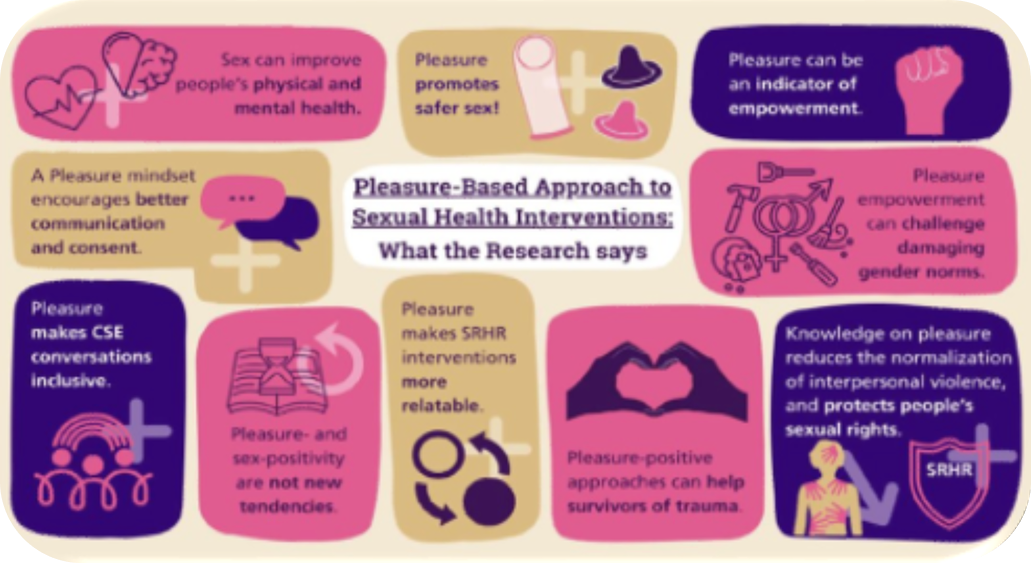
For example:
- Sexual pleasure can have physical and mental health benefits
- A focus on pleasure can promote safer sex
- Pleasure can be an indicator of empowerment
- Pleasure empowerment can challenge harmful gender norms
- Pleasure can make gender equity interventions more relatable
- Pleasure-positive approaches can help survivors of trauma
- Knowledge about pleasure reduces the normalization of interpersonal violence
- A pleasure mindset can encourage better communication and consent
The World Association for Sexual Health has reported on these and other synergies between sexual well-being and gender equity. Many other studies have also found links, for instance, between gender-equal attitudes and better communication about sex, as well as with better body image among adolescents
Therefore, programmes promoting gender equity should also ensure that sexual well-being and pleasure are accessible to all, otherwise they risk overlooking a central element of what it means to live a fulfilling and equitable life.
Therefore, programmes promoting gender equity should also ensure that sexual well-being and pleasure are accessible to all, otherwise they risk overlooking a central element of what it means to live a fulfilling and equitable life.
WHAT IS THE GOOD VIBRATIONS FRAMEWORK?
Good Vibrations aims to inspire and guide you as a person, practitioner, and policymaker in incorporating asset-based approaches to sexual well-being and pleasure into gender equity work. It’s organized around 7 Domains of Delight – seven aspects of sexual well-being that spark both gender equity and sexual pleasure. True to its name, the guide is always in motion, ready to flow alongside those who use it.
The Seven Domains of Delight
1. Sexual joy:
Individuals and communities having the freedom to learn about, imagine, discuss and experience joy in relation to sexuality.
2. Relationship joy:
Individuals having the freedom to learn about, imagine, discuss and experience joy in relationships with married, romantic and sexual partners, friends, family and peers.
3. Self-love:
The freedom to recognize, understand, value, love and care for yourself.
4. Services that make you smile:
High-quality sexual and reproductive health and rights (SRHR) services for all, including access to services, information and education.
5. Safe spaces:
Places for deep, collective learning and conversation about sexual well-being and gender (in)equity.
6. Nurturing communities:
Those that nurture sexual and gender rights and equities and support sexual wellbeing. These are communities that celebrate sexual and gender diversity, are sex-positive and shame-free and promote the sexual safety of all.
7. Equal rights and freedoms:
Ensuring that sexual and gender rights and freedoms are enshrined in law and supported by national, regional and local policies and guidance.
This online guide provides a dedicated section for each Domain of Delight, with practical guidance on how you can create space for sexual well-being in projects, programmes, research and organizations. Good Vibrations contributes to both gender equity and sexual well-being by filling a critical gap in many gender equity programmes, which often overlook sexual well-being and pleasure, despite these being fundamental aspects of quality of life.
Good Vibrations also challenges the privileges and stigma that make sexual well-being and pleasure more accessible to men, heterosexual people and those whose sexual and gender identities are widely accepted in society. It confronts existing “hierarchies”, where society tends to legitimize sexual well-being and pleasure only for those who are gender normative or sexually active within accepted norms such as marriage or specific age ranges, while denying this possibility to others.

Dive into the 7 Domains of Delight


Dive into the 7 Domains of Delight
WHO’S IT FOR?
The Good Vibrations framework is intended for a wide range of people working in gender equity, sexual rights, sexual and reproductive health and education. Its main goal is to help gender equity work go deeper by ensuring that sexual well-being and pleasure are part of the picture.
It is intended as a guide for activists, practitioners, researchers, managers and service providers who want to embed an asset-based approach to sexual pleasure and sexual well-being in their programming and activities. You might also find Good Vibrations useful in your own life, with your friends and lovers.
However, Good Vibrations can also help those working in SRHR to ensure that gender equity and sexual well-being and pleasure are central to their vision for change and success.

HOW CAN I USE THE FRAMEWORK?
How can I use the framework?
Use Good Vibrations to support the development of project proposals, design, delivery, monitoring and evaluation of education and community programmes, health service provision, advocacy and campaign work.
You can focus on a single Domain of Delight or learn about several – they are mutually reinforcing. Some Domains relate more to personal and relational expressions of sexual well-being (e.g. Domains 1—3: Sexual joy, Relationship joy and Self-love) and others to the enabling environments at community and societal level (e.g. Domains 4—7: Services that make you smile, Safe spaces, Nurturing communities and Equal rights and freedoms).
For each of the 7 Domains of Delight, Good Vibrations gives you the following information.
- What it looks like in practice: real-world examples of how focusing on sexual well-being and pleasure can contribute to gender equality.
- Delight diagnostics (i.e. assess your project or organization): tools to assess your project or organization, including key questions to help you, your staff or programme/project stakeholders:
- consider the place of sexual well-being and pleasure in your vision or mission;
- appraise your organization’s programmes, initiatives or activities to determine where you could make space for sexual well-being and pleasure.
- Activities you can use when designing and implementing projects and programmes.
- Outcomes and indicators that incorporate sexual well-being and pleasure and are synergistic with gender equity outcomes.


The Framework also provides resources, case studies and further reading, including:
-
- research on how sexual well-being and gender equity are conceptualized and experienced by individuals, families and communities;
- evidence highlighting the central role of sexual well-being in overall well-being and gender equity;
- “good practice” case studies of existing projects, approaches and tools.
These resources can help you integrate sexual well-being and pleasure into programmes that aim to advance both sexual health and gender equity.
WHY DO I NEED GOOD VIBRATIONS?
Why do I need Good Vibrations?
Most programmes aimed at improving gender equity or SRHR use deficit-based models – in other words, they emphasize risks, vulnerability and negative outcomes from sex, sexuality and gender. This is the case whether the programme relates to health services, community-based outreach programmes, comprehensive sexuality education or other similar initiatives.
While there is value in measuring and recognizing negative outcomes (e.g. to identify unmet needs and find ways to address them), dominant approaches have done so at the expense of recognizing powerful qualities, capabilities, local resources and social values.

An emerging body of evidence suggests that asset-based approaches are an empowering way to create change and to mobilize existing strengths. Asset-based approaches shift the focus from what’s wrong or missing to what is possible; from the weaknesses of stakeholders or communities to their strengths and existing resources. This can take many forms and is typically based on what a local area or population needs, rather than a prescriptive formula that purports to be universally effective. In sexual health, asset-based approaches promote sexual well-being and highlight the positive aspects of sexuality, such as pleasure, emotional connection and a positive body image.

In addition, sex and sexuality are rarely mentioned as an asset in relation to gender equity, except for occasional references to the need for access to SRHR services as an indicator for gender equity. Measures of pleasure and sexual well-being are missing from key indicators of gender equity and empowerment (e.g. those used by the World Bank and the Sustainable Development Goals).
Good vibrations addresses these gaps and brings together important work on sexual well-being, sexual pleasure and gender equity. It offers practitioners a rationale and set of tools and recommendations to promote sexual well-being, pleasure and gender equity for all.
HOW WAS THE FRAMEWORK DEVELOPED?
How was the framework developed?
The Good Vibrations framework is the result of a collaboration between The Pleasure Project, Tabu Tabu and researchers Dr Ester McGeeney and Dr Rachel Wilder. Young and Alive in Tanzania provided additional research and Breakthrough Action supported this project through its extensive global collaboration with SRHR practitioners.
There were three stages:
- Evidence synthesis.
- Qualitative research that explored the intersections of sexual pleasure, sexual well-being and gender equity in practice for communities and service and programme users of Young and Alive in Tanzania and TabuTabu in Brazil.
- A co-production phase where consultants worked with one staff member of TabuTabu and three at The Pleasure Project to develop the Good Vibrations framework.




Further consultation took place with Breakthrough Action, a community of SRHR practitioners, to find out how they would use the framework and what support they would need to integrate it into their work. This took place from November 2023 to June 2024. A further development stage is envisaged, incorporating consultations and feedback from the global community.
Good Vibrations is grounded in academic and grey literature about asset-based models for measuring sexual well-being, sexual pleasure and SRHR. TabuTabu and Young and Alive generated qualitative data through discussions and interviews with local stakeholders, and collaborated in analysing the data and considering its significance for the framework. Good Vibrations further benefited from The Pleasure Project’s 20 years of experience of sex-positive approaches to SRHR.
Drawing on the literature, qualitative research and the expertise of professionals, the 7 Domains of Delight were identified as key aspects of sexual well-being that contribute not only to gender equity but also to overall quality of life.Read more about Good Vibrations
Immerse youself in the other Domains